Annea Lockwood and Claire Chase
Elwha!
Legendary composer Annea Lockwood has been a pioneer of field-recording and deep listening for decades—a composer of “insatiable curiosity” with “a singular ear for the music of the natural world” (The New York Times) and a special focus on the sounds of rivers.
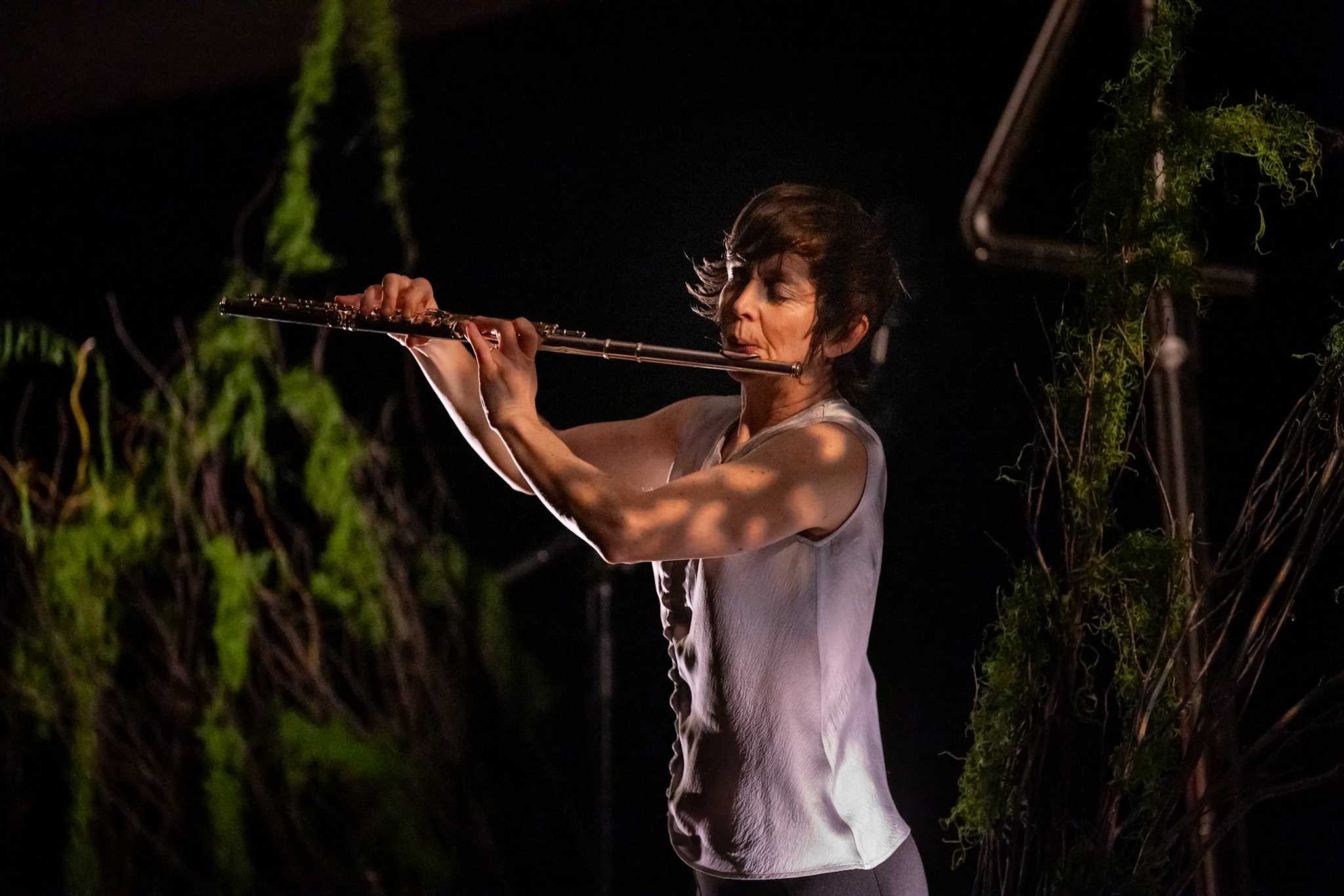
Claire Chase is a musician, MacArthur Fellow, Harvard professor, interdisciplinary artist, and “the most important flutist of our time” (The New York Times).
Here, they meet Washington’s Elwha River as an equal and able creative collaborator in Elwha!
After an astoundingly successful 2011-2014 dam removal project, the Elwha has become a model for ecosystem restoration projects throughout the world: “a thrilling example of what can happen when you take dams out of a river and it takes itself back.”
Elwha! is scored for seven flutes (bamboo water flutes, glissando flutes, piccolos, alto flutes, bass flutes, C flutes, and contrabass flutes), all performed by the brilliant Chase, and multichannel environmental surround sound made from Lockwood’s field recordings of the Elwha.
Chase’s seven flutes respond to the multilayered and kaleidoscopic pitch, rhythmic, melodic, and harmonic material of the Elwha and its many living inhabitants, alternately conversing with, rising above, and being submerged by the wild musics of this iconic, liberated river.
Elwha! premiered in late 2025 at The Kitchen and is a part of Chase’s Density 2036, a 24-year project to develop a new flute repertory leading up to the centennial of Edgard Varèse’s iconic flute solo “Density 21.5” in 2036.
Elwha! by Annea Lockwood, Claire Chase, and the Elwha River
Density 2036: part xii (2025)
Dedicated to the Lower Elwha Klallam Tribe
Elwha! is the 12th cycle of the Density 2036 project
Run time: 45 minutes
Performance Credits:
Claire Chase, flutes
The Elwha River
Sam Torres, live sound
Nicholas Houfek, lighting and production design
Funding & Support:
Elwha! is the 12th cycle of the Density 2036 project. Launched in 2013 by Claire Chase, Density 2036 reimagines the solo flute literature over a quarter-century leading up to the centennial of Edgard Varèse’s seminal 1936 work, Density 21.5. Density 2036 is a project of Density Arts, a nonprofit performing arts and educational organization founded by Chase and based in New York (www.densityarts.org). The Kitchen has been the presenter of all twelve Densities to date.
Elwha! was made possible with generous co-commissioning support from the Fromm Music Foundation, Larry and Arlene Dunn, and the Seattle Symphony Orchestra. Density Arts also gratefully acknowledges the contributions of its donors, volunteers, and community partners.
Annea and Claire wish to extend special thanks to the Lower Elwha Klallam Tribe and the tribal biologist Vanessa Castle, Paul Geluso and Rhiannon Catalyst, Caley Monahon-Ward, Aleks Pilmanis, the Tippet Rise Art Center, and Dr. Kelsie Murchy at the University of Victoria, British Columbia.
Please stay after the performance for a talkback with the artists moderatored by Sam Green (Friday) & Rhiannon Catalyst (Saturday).
Rhiannon Catalyst is an interdisciplinary artist, producer, and author working at the intersection of art, ecology, science, and technology. She creates site-specific immersive performances and installations using voice, spatial sound, light, movement, field and hydrophone recordings, natural reverberation, haptics, and storytelling to illuminate the cultural and ecological significance of place. Her work often listens to rivers, oceans, crossroads, ships, caves, and museums—sites of cultural exchange and intense resonance—and takes form through mythic, ceremonial, and collaborative performance.
For nearly a decade, Catalyst has toured with BELLA GAIA, producing immersive and educational experiences with NASA that weave Earth science, music, and multisensory storytelling. A vocalist and composer working across ambient, dub, dance music, and noise, she recently sound designed Heather Henson’s touring work exploring the migratory cycles of Earth’s flora and fauna. She also worked with Annea, Claire, and her partner, Paul Geluso, on the spatial mix of Elwah!. With Riverkeeper, she creates large-scale public art celebrating Hudson River migration and stewardship through sound, giant puppets, and artist-transformed vessels, connecting immersive experience with direct action for the river. She works closely with Indigenous communities and global peacebuilding organizations including Purpose Earth, Unity Earth, and the Holomovement.
Catalyst has published on altruism and the histories of immersive theatre and sound. Across her practice, she invites audiences to listen more deeply—to one another, to place, and to the more-than-human world—transforming attention into connection, curiosity, and care. www.rhiannoncatalyst.com
Annea Lockwood, Claire Chase, and the Elwha River’s Elwha!
Program Essay by Ihlara McIndoe
Annea Lockwood is fascinated by how a single sound event can be a tiny composition in itself, filled with intricate interior details, and encompassing its own unique structure. An invitation for intensive listening has long been a feature of Lockwood’s creative practice. She is fascinated when a sound shifts out of her control. Rivers, in particular, carry a multitude of gloriously complex and unpredictable sonic potentialities and have their own special sense of agency.
Lockwood has been listening with rivers for decades. Her work with rivers spans countries and includes sound maps of the Hudson (1982), the Danube (2005), and the Housatonic (2010) rivers, as well as recent collaborations on the Schuylkill River with Liz Phillips (2022), and the Columbia River with Nate Wooley (ongoing). Her distinction of listening “with,” rather than “to,” is significant – she sees herself as just one of many organisms that are listening together, within the river environment. For Lockwood, listening offers a special channel of connection, a flow of energy from one phenomenon to another. It’s an ecological perspective that resonates with Claire Chase’s dedication to creating new ecosystems for the music of our time: a flow of vitalizing energy, vibrancy, expansion, creativity, sustenance, and renewal. As collaborators, Annea Lockwood and Claire Chase are acutely attuned to the intimate details of sound and the effect of sound on the human body.
Listening and Making with the Elwha
There is a third key collaborator within Elwha!: the Elwha River itself. Chase and Lockwood approach the Elwha as an equal partner, in the spirit of movements advocating for the personhood and legal rights of rivers, such as in Aotearoa New Zealand, where Lockwood grew up, which in 2017 was the first jurisdiction in the world to grant legal personhood to a river.
The Elwha runs for 45 miles through the ancestral and spiritual home of the Lower Elwha Klallam people, in Washington State. From 1911 to 2014, the river was blocked by two dams which decimated its ecosystem and unlawfully drove the indigenous people of the area from their ancestral lands. In 2014, following a tremendous local and international advocacy effort, one of the largest dam removal projects in National Park Service History was completed, allowing the Elwha to run freely once more through the Olympic Peninsula. Today, the Elwha’s rapid ecological regeneration is, in the words of Lockwood, “a deeply encouraging affirmation of resilience.”
Words alone cannot describe a river
Elwha! is the first of Lockwood’s river works to integrate a human performer right from the inception of the project. Chase and Lockwood prioritized spending time together with the Elwha, taking several trips to explore its sounds, make recordings and discover the ways in which Chase’s ‘voice’ – her flutes – could interweave with the ‘voice’ of the river. In response to these explorations, Chase incorporates an array of live and pre-recorded flutes in the work. Bamboo water flutes, glissando flutes, piccolos, bass flutes, C flutes, and contrabass flutes converge with the river’s multifaceted sound, diffused throughout the performance space through a seven-channel mix.
The work opens above the surface of the water, with the wild call of an elk and an uncanny response from Chase, who explores the whinnying potentials of a bamboo water flute. A cloud of bamboo water flutes (six pre-recorded by Chase, and one performed live) slowly shifts as the life of the river awakens. There’s a magic in not quite knowing where the wind along the riverbank becomes breath through the flute, or where rapidly rearticulated flute murmurings transform into the fluttering wings of a bird.
Lockwood says that “words alone cannot describe a river, because words are not multisensory.” Sound, however, is a bodily experience, and in Elwha!, one feels as if gently immersed in the river itself. Soft splashes of water over rock adopt an almost tactile physicality in the space, emerging from the surround mix like the spray of a river caught in the wind, cool and refreshing on the skin. Chase’s many recorded layers of bamboo flutes, sliding in pitch as they are dipped in and out of water, carry us into the river with the contour of its intricate currents. A moment of improvisation with the Elwha is captured using the hydrophone, dipped into the river and slowly lowered and lifted, performing with the Elwha as a living instrument, and sonically evoking a liquid xylophone.
Reflections of being
Lockwood’s recorded river sounds are not artifacts to be manipulated like motifs in a composition. Rather, she hears them as articulations of the river’s being, and as invitations to collaborate with the non-human world. Chase accepts the Elwha’s invitation into the entanglement. The voice crafted through her many flutes is one which is woven from the rich pitch and rhythmic material of the Elwha, informed by research assistant Aleks Pilmanis’s detailed transcriptions of the river’s music. The river’s vital song emerges, manifested through Chase’s solo platinum flute, carrying us through a winding journey, before finally coming to rest within a cluster of flute voices. With each of the seven flutes dispersed to a different speaker, the interplay of breath and sound is highlighted with wonderful immediacy and proximity. These sonorities evoke a reverence in their resonance and a vibrancy in their timbral twisting, until eventually dissolving into a cadenza of whistling tones, like spirits in the wind. The rich and haunting voices of seven bass flutes then draw us to someplace dark and deep, while soft splashes from the water’s surface and birds high in the trees above sprinkle the space with lightness.
In the salmon pool
The poignant low flutes become occasionally accented by short grunting evocations, squelchy voices with a güiro-like timbre to them. The source? Farting salmon! These striking moments were recorded by researcher Dr. Kelsie Murchy of the University of Victoria, British Columbia, who generously allowed Lockwood and Chase to incorporate them. Since the liberation of the Elwha in 2014, its fish life – including all five species of native Pacific salmon and four species of anadromous trout – is returning in a demonstration of extraordinary resilience.
Lockwood was eager to collect sound recordings during the fall Chinook salmon spawning migration. She and Chase had already connected with David Tye, a fisheries researcher and resident of the area who knows the Elwha and its fish species well. Tye knew exactly where to find the salmon in their migratory return, and assisted Lockwood in recording near a logjam, which members of the Lower Elwha Klallam Tribe had constructed as a place for salmon to rest. The resulting recording is included within Elwha! and runs long and uninterrupted. We sit within this fishy world, the solo river dispersed through the seven speaker channels, swirling, currents bouncing off the logjam in intricate polyphonies as we listen to the mysterious exchanges of the salmon, the swishes and flaps of their tails.
A convergence of energies
The arrival at the river mouth is marked by the rising of many bubbling, tapping, whistling, thudding, rustling, gurgling, droning, bellowing layers emanating, gaining momentum, and eventually surging with urgency. Seven contrabass flutes are at the center of this convergence of energies at the climax of the work. As the mass of contrabass flutes fades, the glissandi voices of the bamboo water flutes re-emerge. We are left with Chase alone in the space with the diffused voice of the Elwha around her. We have followed the Elwha to its convergence with the ocean.
To experience this work is to join in celebrating the liberation of the beautiful Elwha River, and to tune one’s ears to movements around the world advocating for more reciprocal, relational ways of being with and caring for waterways. Words alone cannot describe a river, nor can they adequately describe this work: it is better to listen.
Claire Chase, described by The New York Times as “the North Star of her instrument’s ever-expanding universe,” is a musician, interdisciplinary artist, and educator. Passionately dedicated to the creation of new ecosystems for the music of our time, Chase has given the world premieres of hundreds of new works by a new generation of artists. She was the first flutist to be awarded a MacArthur Fellowship in 2012, and in 2017 was the first flutist to be awarded the Avery Fisher Prize for Classical Music from Lincoln Center. Chase served as the Richard and Barbara Debs Creative Chair at Carnegie Hall in the 2022-23 season and as the Music Director for the 2025 Ojai Music Festival.
Chase has performed recently as a soloist with the New York Philharmonic, Los Angeles Philharmonic, San Francisco Symphony, Seattle Symphony, Netherlands Radio Orchestra, Helsinki Philharmonic, Kyoto Symphony, BBC Scottish Symphony, Munich Chamber Orchestra, and London Philharmonia. Her discography includes twelve acclaimed solo albums and dozens of collaborative recordings across genres. As an undergraduate, Chase founded the International Contemporary Ensemble and served as the organization’s artistic director from 2001-2016. A deeply committed educator, Chase is currently Professor of the Practice in the Department of Music at Harvard University and a Creative Associate at The Juilliard School.
Annea Lockwood’s music ranges from sound art and environmental sound installations to concert music. Recent works include three collaborations: Into the Vanishing Point with Yarn/Wire, Becoming Air with Nate Wooley and Skin Resonance with Vanessa Tomlinson. Water has been a recurring focus of her work and her sound maps of rivers: the Hudson River, the Danube, the Housatonic River, and with Liz Phillips the Schuylkill, have been widely presented. A sound map of the Columbia River with Nate Wooley is nearing completion, supported by a grant from New Music USA.
A Fromm Music Foundation commission was recently awarded for Elwha! and a grant from the New York State Council on the Arts supports a new installation for PS 21, Chatham, New York. Lockwood is a recipient of the SEAMUS Lifetime Achievement Award 2020, and is a member of the American Academy of Arts and Letters.
Sam Torres Professional listener Sam Torres is a musician, audio engineer, and concert producer. He makes improvised music with his saxophone and an ever-evolving, custom-designed system of electronic instruments. As the owner and mastering engineer of Polymouth Mastering in Troy, NY, he helps musicians from around the world make their music sound as impactful and professional as possible. Sam and his partner Sophia Vastek co-founded S&S Presents, an award-winning concert curation and production company that hosts shows at Troy Savings Bank Music Hall and at their home, Troy Listening Room.
Sam spent his early years as an audio engineer working across North America, mixing live events ranging from chamber ensembles with spatialized live electronics to rock bands of all sizes and recording orchestral concerts in classical halls. In 2020, Sam turned his engineering attention to mastering, and has mastered projects for artists ranging from a Colin Stetson collaboration to rapper Murs and jam band Dogs In A Pile.
Nicholas Houfek is a NYC-based Lighting Designer and Lighting Artist. Frequent and recent collaborations include: International Contemporary Ensemble, Marcos Balter’s Oyá with the New York Philharmonic (Soloist for Light), Claire Chase, Nathalie Joachim, Ojai Music Festival, Silk Road Ensemble, Marc Neikrug’s A Song by Mahler, Anohni’s She Who Saw Beautiful Things, Suzanne Farrin’s La Dolce Morte, George Lewis’ Soundlines, Anna Thorvaldsdottir’s In The Light of Air, and Ash Fure’s The Force of Things. He is an ensemble member of the International Contemporary Ensemble, a member of USA829, and a graduate of Boston University.