International Contemporary Ensemble
Listen to the Cry of the World
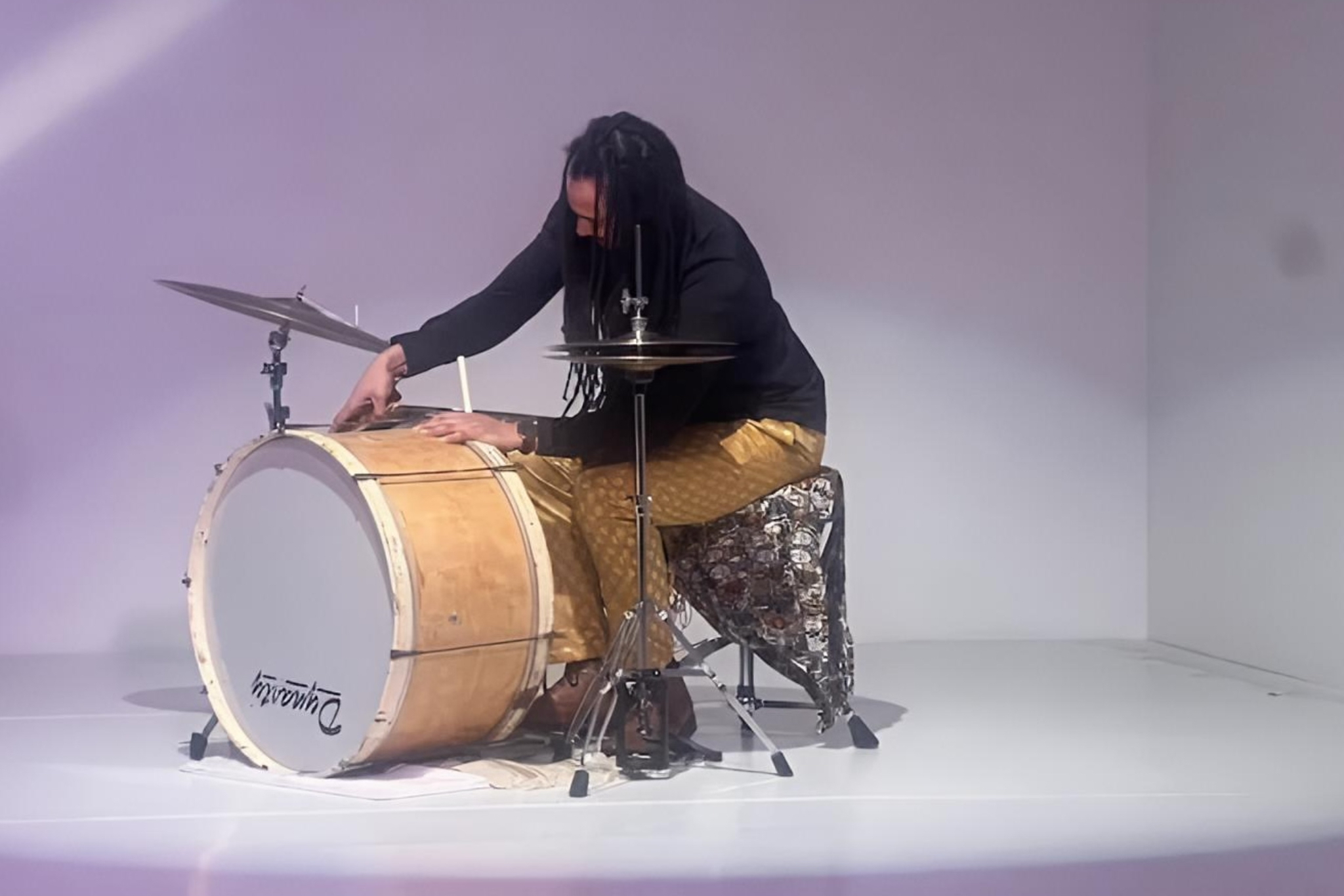
Listen to the Cry of the World, by composer, drummer, and scholar Jessie Cox, is the inaugural project of the Cheswatyr Incubator, a collaboration between PS21, International Contemporary Ensemble, and the Cheswatyr Foundation. Exploring ecology and Blackness, the work draws inspiration from Martinican philosopher Édouard Glissant to consider relations between people, environments, technologies, and histories.
Developed in close collaboration with musicians of International Contemporary Ensemble through two workshops in Brooklyn, the project continued with a week-long residency at PS21. During the residency, Cox and the ensemble developed a site-responsive acoustic installation connecting PS21’s Pavilion Theater with the surrounding woods. Voice, instruments, trees, strings, and electronics became part of a single resonant system, with sounds migrating, distorting, and decaying across connected materials.
The residency culminated in the world premiere of Listen to the Cry of the World at PS21, performed by ten musicians of International Contemporary Ensemble and conducted by Vimbayi Kaziboni.
Described as “America’s foremost new-music group” (The New Yorker), International Contemporary Ensemble is dedicated to supporting living composers through commissioning, developing, and premiering new works. Now in its third decade, the Ensemble has premiered over 1,000 works and plays a pivotal role in launching and shaping the careers of today’s most influential composers. Through its bold programming and innovative curation, the Ensemble continues to redefine the possibilities of contemporary music.
The Ensemble has brought its vision of a mosaic musical ecosystem to festivals and venues all over the world including Carnegie Hall, Maerzmusik/Berliner Festspiele, Warsaw Autumn, Miller Theatre Composer Portraits, Museum of Modern Art New York, Centre for Contemporary Arts Glasgow, HEAR NOW Los Angeles, Darmstadt International Summer Courses for New Music, NYU Skirball, Pioneer Works, Oberlin College, House of World Cultures, TIME:SPANS Festival, Big Ears Festival, Adelaide Festival, the Dutch National Opera, Cité de la Musique (Paris), Haus der Kulturen der Welt (Berlin), Walt Disney Concert Hall, Metropolitan Museum of Art, and Japan Society.
Through trailblazing initiatives such as the Call for ____ Commission Program and Ensemble Evolution (in partnership with The New School’s College of Performing Arts), the Ensemble has had a major impact on the contemporary performance ecosystem in New York City, nationally, and internationally, by supporting the creativity of their composer-collaborators, as well as presenting workshops and performances for hundreds of student composers. Many of the Ensemble’s composer-collaborators have developed highly influential careers, such as Du Yun, who won the 2017 Pulitzer Prize for the opera Angel’s Bone, which the Ensemble developed and premiered, and MacArthur Fellows Tyshawn Sorey and Courtney Bryan.
Jessie Cox is Assistant Professor of Music at Harvard University. A composer, drummer, and scholar, his work engages experimental music as a site of critical inquiry, bringing together music studies, Black studies, and critical theory. His first monograph, Sounds of Black Switzerland: Blackness, Music, and Unthought Voices (Duke UP, 2025), explores how experimental musical practices and thinking with Blackness open alternative ways of worlding.
Cox’s compositional practice spans avant-garde classical music, experimental jazz, and sound art. His music is often described as speculative or Afrofuturist in orientation, engaging questions of time, space, and collective imagination. It has been noted for its distinctive textures, structural instability, and expressive intensity; writing in The New Yorker, Alex Ross has described Cox’s work as an example of “dynamic pointillism,” marked by “breathy instrumental noises, mournfully wailing glissandi, and climactic stampedes of frantic figuration.” He has worked with ensembles and institutions including the Sun Ra Arkestra, the Los Angeles Philharmonic, and Klangforum Wien. He has received a Fromm Foundation commission, a Civitella Ranieri Fellowship, and the ASCAP Fred Ho Award.
Alongside his compositional work, Cox’s scholarly writing advances practice-based approaches to music as a form of research. His writing appears in Composing While Black, liquid blackness, Critical Studies in Improvisation, Sound American, American Music Review, Musik-Diskurse nach 1970, and others.